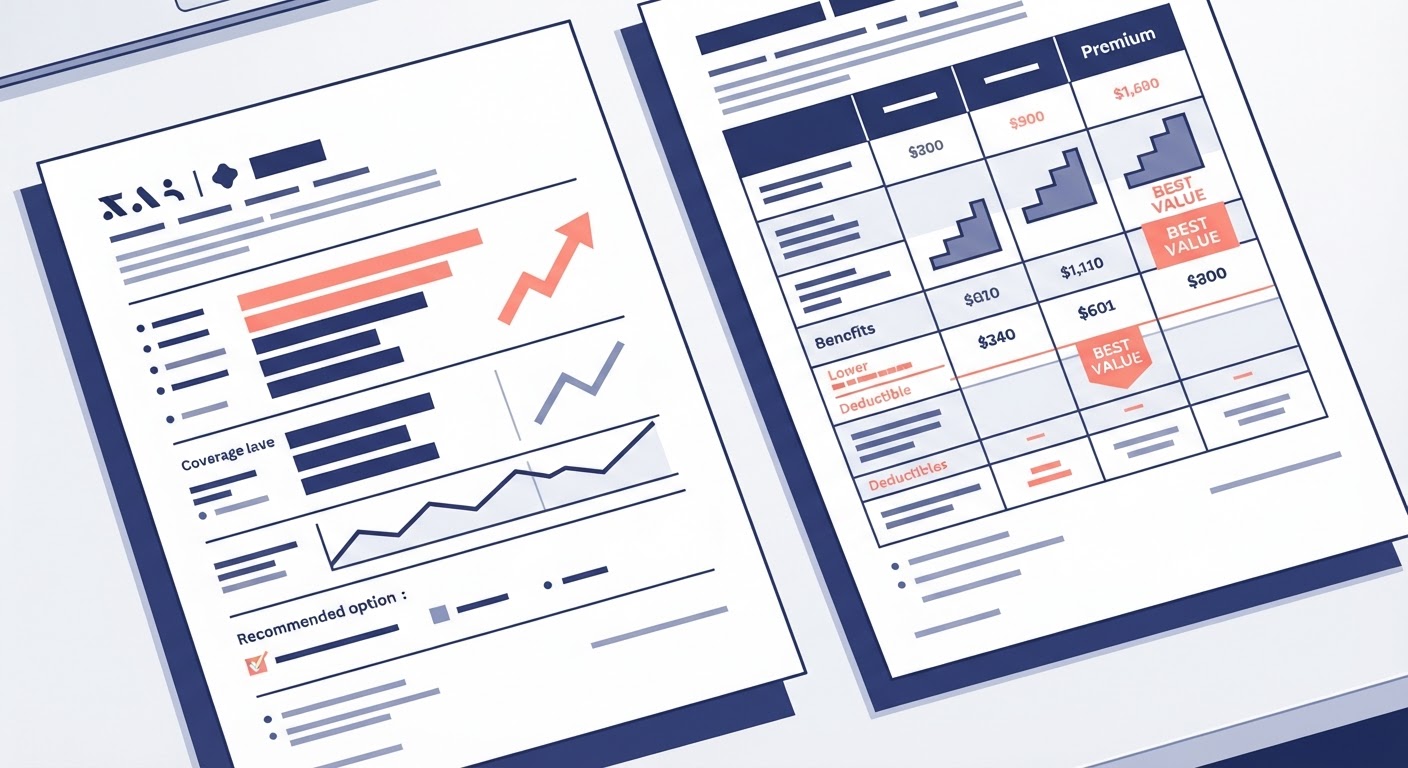
You pull up three quotes side by side. One is noticeably cheaper than the other two. Every instinct says take it. But that instinct is built for shopping where the product doesn’t change from seller to seller — a gallon of milk, a flight on a given day. Car insurance doesn’t work that way. Two policies with the same monthly price can protect you in wildly different amounts, and two policies with different prices can be functionally identical except for one number buried on page two. The lowest figure on the page is only meaningful once you know what it’s attached to.
This matters because insurers aren’t required to show you the same policy structure by default. When you request a quote, most tools default to whatever limits and deductibles that carrier considers “standard” unless you tell them otherwise. Different carriers have different defaults. So when you compare four quotes without adjusting anything, you’re often not comparing four prices for one product — you’re comparing four different products that happen to share a category name.
Why the lowest number on the page isn’t automatically the best deal
A quote is a price attached to a specific set of promises. The promises are: how much the insurer will pay out if you cause damage to someone else, how much you’ll owe out of pocket before your own coverage kicks in, and which situations are covered at all. Strip any one of those down and the price drops — not because the insurer found efficiency, but because they’ve agreed to cover less.
Think of it less like comparing prices and more like comparing job offers that list different salaries without telling you the hours, the benefits, or what the role actually involves. The number alone tells you almost nothing until you can see what it’s buying.
The reason this trips people up isn’t stupidity — it’s that the cheaper quote is usually still a real, legitimate policy that will pay out in some circumstances. It’s not a scam. It’s just thinner. You might not notice the thinness until you’re the one filing a claim after an expensive accident, at which point the gap between “covered” and “covered up to a limit that doesn’t reach the actual cost” becomes the most important fact in your financial life for a while.
So the fix isn’t to distrust cheap quotes on principle. It’s to stop reading the price first. Read the structure first, then the price.
Lining up liability limits, deductibles, and add-ons before you look at price
Before any two quotes are comparable, three things need to match, or at least be understood in relation to each other.
Liability limits
Liability coverage is what pays for the other person’s damage and medical costs when you’re at fault. It’s usually expressed as a set of numbers — for example, a per-person injury limit, a per-accident injury limit, and a property damage limit. Every state sets a legal floor for these limits, and that floor is genuinely low relative to the cost of a serious collision. Carriers are happy to quote you at that floor because it produces the smallest possible number on the screen. It also means that if you cause an accident that costs more than your limit, the difference comes out of your own assets, not the insurer’s.
Look up your state’s current minimum requirement directly with your state’s department of insurance or DMV site before you shop — don’t rely on a number you saw somewhere else, and don’t assume the quoted default is the minimum or is adequate for your situation. Then decide, independent of any quote, what limit you actually want to carry. Once you’ve picked that number, request every quote at that same limit. That single step eliminates the most common reason two quotes look far apart.
Deductibles
Your deductible is what you pay out of pocket before collision or comprehensive coverage pays the rest. A higher deductible almost always produces a lower premium, because you’re absorbing more of the small-to-medium losses yourself and the insurer is only on the hook for the larger ones. That trade can be a perfectly reasonable choice if you have the cash reserve to cover the deductible comfortably. It’s a bad surprise if you picked the cheap quote without noticing the deductible had quietly doubled.
Write down the deductible on each quote before you look at the price. If they don’t match, adjust them to match before comparing anything else.
Add-ons and optional coverages
This is where quotes diverge the most and where the differences are easiest to miss, because add-ons are often listed in small print or bundled into a single line labeled something generic like “extra protection.” Common examples include:
- Rental reimbursement while your car is being repaired
- Roadside assistance
- Coverage for a loan or lease balance that exceeds your car’s value after a total loss
- Coverage for damage caused by a driver who has no insurance or not enough of it
- Coverage for medical costs or lost income regardless of who caused the accident, which is handled differently depending on the state
None of these are optional in the sense of being unimportant — some of them matter enormously depending on your situation, particularly if you’re still financing the car or drive in an area with a lot of uninsured drivers. The point isn’t that you need all of them. The point is that a quote missing three of these next to a quote including all three will look cheaper for reasons that have nothing to do with efficiency.
The line items that quietly differ between two “similar” quotes
Once limits, deductibles, and add-ons are aligned, there’s still a second layer of differences that don’t show up as a clean line item but change what you’re actually buying.
How the car’s value is set for a total loss
If your car is totaled, the insurer pays out based on its assessed value, not what you paid for it or what you think it’s worth. Carriers use different data sources and different methods to arrive at that number, and two insurers can land on noticeably different valuations for the identical car. This isn’t visible in a quote at all — it only shows up after a total loss claim. You can’t fully compare this in advance, but you can ask each carrier, before you buy, what valuation method they use and whether they offer any option to guarantee a specific payout structure.
Which repair shops and parts you’re steered toward
Some policies favor a network of approved repair shops or use aftermarket parts rather than parts made by the original manufacturer, and disclose this in language you can easily skim past. This can affect repair quality, turnaround time, and whether your car looks and drives the way it did before the accident. It’s worth asking directly whether a policy uses aftermarket parts by default and whether you can opt for original manufacturer parts, since that option sometimes costs more but changes what “repaired” actually means.
How a claim affects your future premium
Some policies include a form of forgiveness for a first at-fault accident, meaning your rate doesn’t spike the way it normally would after your first claim. Others don’t, or offer it only after you’ve held the policy for a certain length of time. This has zero effect on the price you’re quoted today but a real effect on what you’ll pay two years from now if you have an accident. It’s a comparison point that’s easy to forget because it lives in the future rather than on the page in front of you.
Usage-based or telematics programs
Some quotes include a discount contingent on a monitoring app or device that tracks your driving. The quoted price may assume you’ll qualify for the full discount, when in practice the discount is earned gradually and can be reduced by hard braking, late-night driving, or phone handling detected during trips. If a quote looks unusually low, check whether part of that price depends on a telematics program and what the price reverts to if you don’t participate or don’t qualify for the maximum discount.
Payment structure fees
The premium itself might match another quote almost exactly, but one insurer charges a fee for monthly installment payments while another doesn’t, or one requires a higher upfront payment to activate coverage. These aren’t dramatic differences individually, but they change the real cost of the policy over a year, and they’re rarely presented next to the headline number.
A short checklist for confirming you’re comparing the same policy
Before you make a decision based on price, go through each quote and confirm the following are identical or, where they differ, that you understand exactly how and why:
- Liability limits — per-person, per-accident, and property damage — are set to the same numbers on every quote
- Deductibles for collision and comprehensive coverage match across every quote
- The same optional coverages are either included on all quotes or excluded from all quotes, not present on some and missing from others
- You know whether the price assumes participation in a telematics or usage-based program, and what the price would be without it
- You’ve asked each carrier how they determine a vehicle’s value in a total loss
- You know whether the policy defaults to aftermarket parts and whether original manufacturer parts are available as an option
- You know whether there’s a form of accident forgiveness and what qualifies you for it
- You’ve accounted for any installment or processing fees in the total annual cost, not just the monthly number
- The discounts applied to the quote — for bundling, safety features, driving history, or anything else — are ones you actually qualify for, not ones assumed by default
Once every item on that list matches, the price difference remaining between quotes is a real, meaningful difference — the same product at different prices, which is the only kind of comparison that tells you anything useful. Everything before that point is just noise dressed up as a deal.
